
You’re reading You Can Tell Me with your ten-year-old when he points to Uncle Ben and asks, “Does God still love him?” Maybe you were expecting that question. Maybe you were hoping to make it to the end of the page first.
Either way, you can take a deep breath. You have time to ask your child what he’s wondering and give him an age-appropriate answer that points to God’s wisdom. And after you close the comic, you’ll have another chance to talk tomorrow.
You Can Tell Me gives you a story designed to draw kids in and give parents an opening for conversations that feel difficult to start. This short guide is designed to answer questions your child may ask and help you respond if she discloses a brokenness, sin, concern, or unexpected confession.
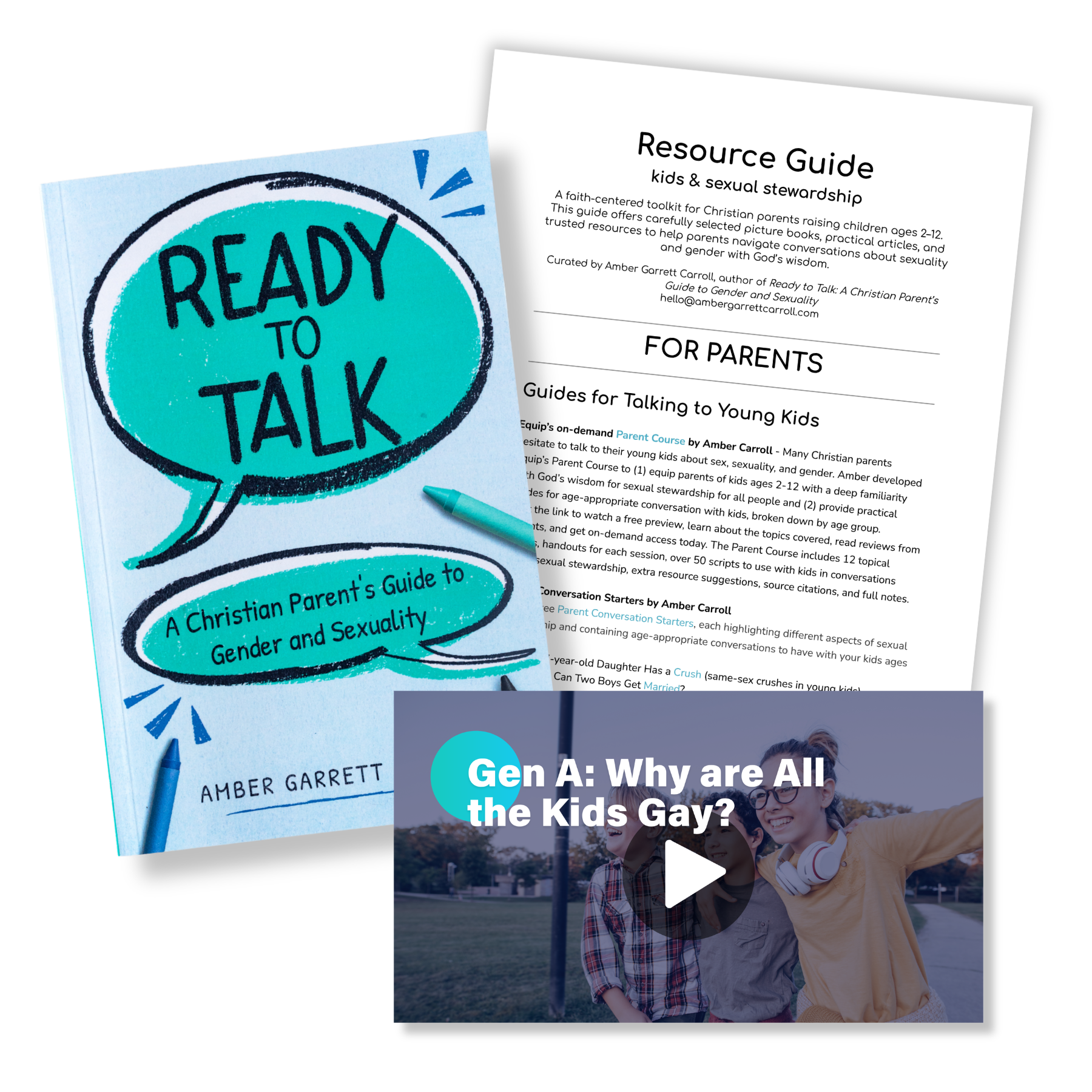
For even more help preparing for conversations about sex, sexuality, and gender, check out my book, Ready to Talk: A Christian Parent’s Guide to Gender & Sexuality. I wrote it for Christian parents of kids ages 2-12 who want to have age-appropriate, theologically accurate conversations with their kids about God’s good wisdom for sexual and gender stewardship. It includes over 50 conversation scripts, thought-provoking questions for parents to consider, and an in-depth exploration of what the Bible has to say about LGBT+ topics.
Is ten too young to talk about sexuality and gender?
By age ten, some kids have already entered puberty. They can understand that someone might have a crush or feel uncomfortable in their body, and they probably worry that telling you something personal might change how you or others feel about them. The key is to keep conversations age-appropriate and use kid-friendly language.
At some point, your kids will learn about sex, sexuality, and gender. If you’re not the one teaching them, someone else is. The Enemy, culture, misinformed friends, teachers and coaches, Disney, and TikTok are more than ready to step in.
None of our kids is exempt from needing to learn about God’s wisdom for sexual stewardship, and brokenness will affect all of our kids, in some way, before their adult years.
Plus, by age the early teen years, most kids’ core beliefs are well-established and no longer easily malleable. It’s wise to share with kids what you want them to know about God’s wisdom for sexual and gender stewardship and God’s love for sexual and gender minorities before they enter puberty and continue those conversations throughout childhood and the teen years.
What I want my kids to hear at ten (and thirteen and seventeen and twenty-two) is this: “You can ask me about the sex and gender stuff. And if it ever gets personal, you can tell me that too.”
Before you read, set the stage
Notice what you’re afraid of. Are you worried you’ll use the wrong word? That your child will tell you something you feel unprepared to hear? Fear is understandable, but we can’t allow our fear to silence us. Take your fear to the Lord before you sit down with your child. You might pray, “Jesus, I feel a little weird talking to my kid about sexuality and gender. I don’t want to be condemning, and I don’t want to give my kid the wrong impression about your wisdom. I’m worried I won’t have all the answers. Help me to be confident in your wisdom and goodness, and help me to listen well.” If you’re surprised by a question your child asks and need more time to process or find an answer, it’s totally ok to say, “I want to think about that with you. Can we come back to it tomorrow?” Then come back to it.
Choose an ordinary moment. Sit side by side on the couch, at the kitchen table after everyone else has wandered off, or wherever you already read together. Pick a time when you can put your phone down and your child can ask questions without siblings or other adults listening in. Try to ensure others won’t interrupt. If you only get through a few pages because your child wants to talk, you can pick up the story another day.
Check your tone. If you’re anxious, you child will be anxious, too. Speak in a calm, clear voice. A quiet voice will signal that the topics are too taboo to speak about publicly, and rushed reading tells your child that her questions are not important. You don’t need to be silly, but don’t be too serious either.
Start with the story. “Hey, I found a comic about a kid who goes to a family party and comes home with some big questions. Want to read it with me?” Read at your child’s pace.
Repeat and rephrase. When your child has a question or a thought to share, pause and discuss it. Repeat their question back to them and ask clarifying questions like. “What have you heard about that?” “ Tell me what you are wondering about,” or “What do you already know about that?”
Reassure your child. “You can tell me about anything that surprises you or feels hard to say. I’m glad to listen, and we can ask Jesus for wisdom together.” If you’ve reacted sharply to a question before, you can name that too. “I remember how I answered last time you shared something personal. I wish I’d listened first. I want to do that now.”
For more help with timing, tone, and age-appropriate answers, start with chapter 11 of Ready to Talk.
Five questions a ten-year-old might ask
Give simple, honest, factual answers. Give the information that is needed, in an age-appropriate way. Leave the conversation open to more discussion if you child has additional questions or thoughts to share.
1. “What does it mean that Uncle Ben is gay?”
“It means he’s attracted to other men. For some people, that feels like having a crush on someone of the same sex. Uncle Ben didn’t choose who he was attracted to, and who he’s attracted to is just one part of his story. What were you wondering about him?”
2. “Does God still love Uncle Ben? Could he get married?”
“Yes. God loves Uncle Ben, and we do too. Here in the United States, two men can legally get married. Our family believes Jesus teaches that Christian marriage is a lifelong covenant between one man and one woman and that it has a gospel purpose. And people who stay single can have a life full of love, with close friends and people who are family to them. I want us to be that kind of family to people like Uncle Ben.”
3. “Why did they say Sam was ‘too girly’?”
“Some people have narrow ideas about what boys and girls are supposed to like. A boy can enjoy bright shoes or have a gentle voice. He’s still a boy. Sam also sometimes feels uncomfortable with being a boy, and that can be hard for him. He deserves friends who listen and treat him kindly. What could you do if you heard someone teasing a boy who feels the same way as Sam?”
4. “Did Becca do something wrong? Is that why she can’t have a baby?”
“No, she didn’t do anything wrong. Because of the Fall, everyone experiences brokennesses they don’t choose. For some people, that brokenness means their body can’t have a baby. For some, it means they experience attraction to people of the same-sex. There are many different ways our body, mind, or soul can experience brokenness we don’t choose. When you find where brokenness shows up in your life, I hope you’ll tell me about it. I want to comfort you and help you follow God’s good wisdom for your life.”
5. “What if I notice something like that about myself?”
“You can tell me, even if you’re still figuring out what you mean. You won’t be in trouble for having a feeling or a question. I love you, and Jesus loves you. We can talk about what you’re noticing and take our time as we figure out how to follow Jesus together.”
What if your child comes out right then?
You finish reading and your child says, “I think I’m like Uncle Ben, I have crushes on other girls, even though all the other girls have crushes on guys,” or “I think I might be like Sam; I don’t always feel like a boy on the inside.” You’ll likely have lots of conflicting emotions. Fear may take hold, or your mind may fill with dozens of questions. I encourage you to start with the words your child needs to hear from you:
“Thank you for telling me. I love you. I will always love you. I’m glad you trusted me with this. You are very brave. You’re my kid, and I’m going to be here with you no matter what. I really want to hear your whole story. This is your home, and we are your family. Always.”
Remember, you don’t need to change your beliefs about God’s good plans for sexual relationships or bodies nor do you need to adopt a revisionist sexual/gender ethic to respond to your child with love, grace, humility, and compassion.
Let them tell you what their words mean. If they say they’re gay, listen to what they’ve noticed about their attractions and what it’s been like to carry that. If they say they’re trans, ask what that word helps them describe and what has felt hard. You can take your child seriously while giving them time to tell you more. You can also come back to decisions or questions about faith as those conversations unfold.
Ask one question at a time. “What were you most worried I’d say?” or “What would help you feel supported tonight?” may tell you more than a string of questions about theological convictions. Give your child room to pause. If they want to get a snack or go back to watching a show with you, let the ordinary parts of your relationship reassure them too.
Come back to the conversation. Ask who already knows and talk with your child before sharing with anyone else. Find a way to process your own feelings without making your child responsible for them. The next day you might say, “I’m still glad you told me. How are you feeling about our conversation today?” If you froze or said something hurtful, name it and try again.
Chapters 21 and 24 of Ready to Talk go deeper on what to say in the first conversation and how to stay close in the days and months that follow.
What if your child barely says anything?
Your child may shrug, ask what’s for dinner, or want to read the funny part again. Let them. A few days later, while you’re doing something ordinary together, ask, “Was there anything in that story you’ve been thinking about?” Make conversations about God’s wisdom for sexual and gender stewardship a regular rhythm in your home so kids know they’re always welcome to bring it up.
Keep talking
To keep talking about God’s good design for relationships, bodies, family, and more, check out Ready to Talk: A Christian Parent’s Guide to Gender and Sexuality. It includes over 50 age-specific scripts and fuller guidance on friendship and family, Christian marriage and vocational singleness, same-sex attraction, and gender. If you’d rather learn by video, explore Equip’s on-demand Parent Course.
When your child asks about marriage, crushes, or family
- “Mom, Can Two Boys Get Married?”
- My 7-Year-Old Daughter Has a Crush
- Parent Conversation Starter: Intimacy & Family
- Parent Conversation Starter: Sexual Ethics
- Parent Conversation Starter: Christian Singleness
When your child asks about gender
When you want to talk about coming out, shame, or how we treat people
- Parent Conversation Starter: Gay Pride & Coming Out
- Parent Conversation Starter: Responding to Shame
- Parent Conversation Starter: Preventing Homophobia
- Parent Conversation Starter: Causes & Change